The AI-Native SDLC: How AI Is Rewriting Every Phase of Software Development

The AI-Native SDLC: How AI Is Rewriting Every Phase of Software Development
In 2024, I watched a junior engineer on my team ship a feature in two hours that would have taken me a full day in 2022. They weren't faster typists. They were working with an AI coding agent that drafted the implementation, wrote the test suite, and opened a PR — all from a single natural-language prompt. My job as their PM wasn't to assign subtasks anymore. It was to make sure the intent was right before the machine started executing.
That moment crystallized something I'd been sensing for a while: the software development lifecycle as we've practiced it for decades is being fundamentally restructured. Not by a new framework. Not by a new project management methodology. By AI systems that are inserting themselves into every phase — from how we gather requirements to how we monitor production systems at 3 AM.
Here's what I'm seeing, what the data actually says, and where I think the honest risks lie.
The Old Pain: Why Every SDLC Phase Was Ripe for Disruption
If you've shipped software professionally, you know the real bottlenecks were never just about writing code. The classic six-phase SDLC — requirements, design, implementation, testing, deployment, maintenance — has a dirty secret: most of the friction lives in the handoffs between phases, not the phases themselves.
GitLab's 2026 Global DevSecOps Report found that fragmented tooling still costs teams 7 hours per person per week. That's nearly a full working day lost to context-switching, waiting for reviews, and chasing artifacts across systems. Developers lose flow toggling between Jira, Slack, their IDE, and whatever observability dashboard is currently on fire.
And here's the structural problem: governance — security, compliance, quality — has traditionally been bolted on at the end. You write code for two weeks, then a security review catches an issue that forces a rewrite. The feedback loop is measured in sprints, not seconds.
The result? We've been measuring delivery velocity in story points while hoping it correlates with business value. It usually doesn't.
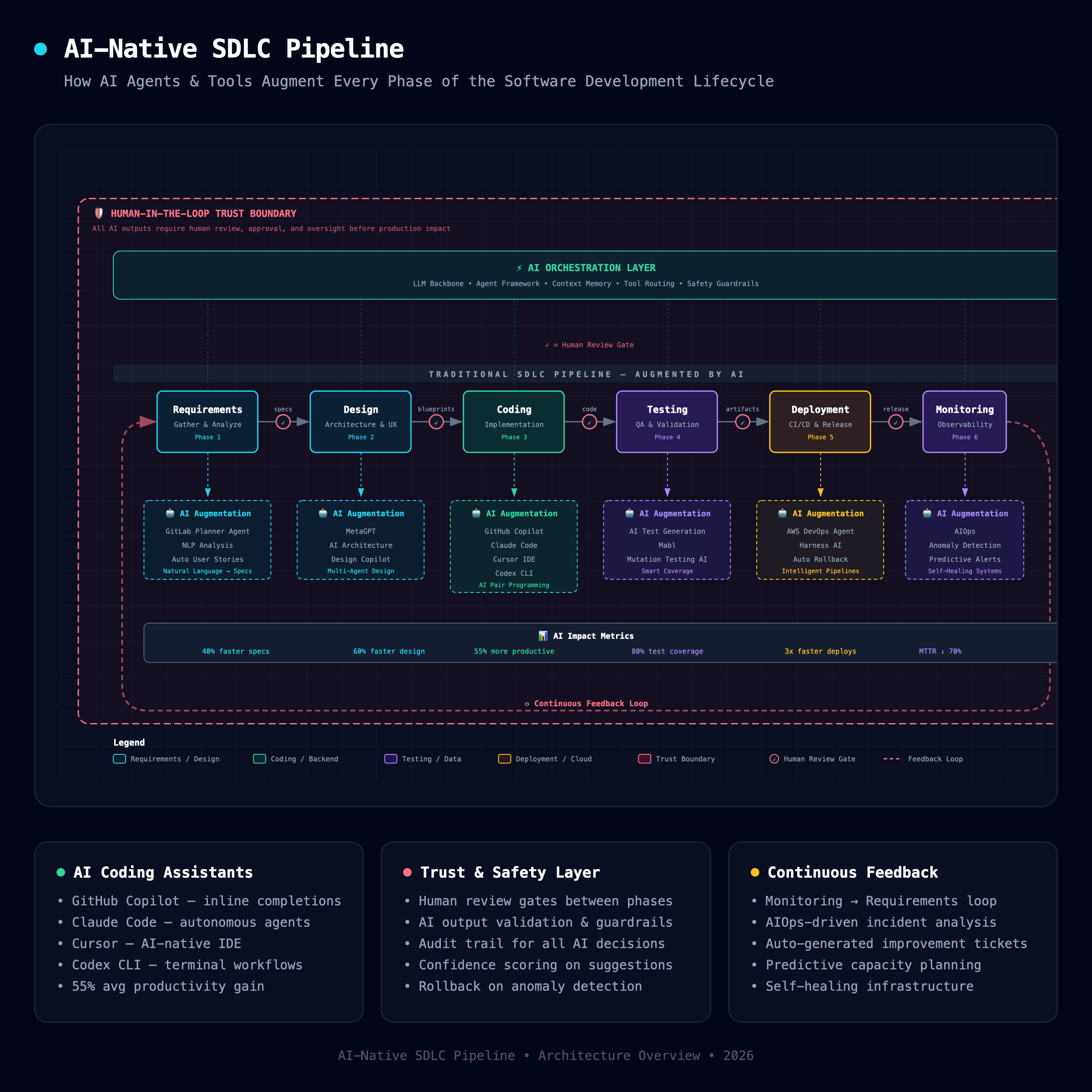
AI Augmentation, Phase by Phase
Requirements & Planning: From Ambiguous Narratives to Structured Intent
Requirements gathering has always been the phase where the most damage is done with the least visibility. Stakeholders describe what they want in natural language, a PM translates that into user stories, and by the time it reaches a developer, the original intent has been through three rounds of lossy compression.
AI is attacking this directly. NLP-powered analysis tools now parse stakeholder narratives, flag ambiguity and conflicting requirements, detect regulatory clauses, and derive user stories with traceability links to risks and controls. GitLab's Planner Agent, generally available since January 2026, automates the flow from issue creation to merge request.
What's more interesting is Anthropic's AI-native SDLC framework, which treats operational data — production metrics, incident reports, user behavior — as the next planning input automatically. Instead of waiting for a quarterly retro to discover that 40% of your API calls are hitting a deprecated endpoint, the system closes the loop from maintenance back to requirements on its own.
The human role here isn't disappearing. It's becoming more important: you need to specify intent with precision, because a vague prompt to an AI planner produces vague stories at machine speed.
Design & Architecture: Humans Move Upstream
AI tools can now reconstruct evolving system architecture via code embeddings, predict the blast radius of dependency changes, and guide refactoring decisions with ROI estimates. Multi-agent systems like MetaGPT instantiate specialized roles — Product Manager, Architect, Engineer, QA — each operating under standardized procedures and negotiating trade-offs through structured communication.
Here's the counterintuitive finding: while AI reduces the build phase duration by roughly 40%, the time allocated to architecture and strategy increases. The human role shifts from producing the first draft to directing, checking, and deciding what to keep. That's the right trade. Architecture mistakes are expensive; typing speed never was the real constraint.
Coding & Implementation: The Phase Everyone's Watching
The adoption numbers are staggering. DORA's 2025 report, surveying roughly 5,000 developers, found 90% are using AI coding tools. Black Duck's March 2026 survey of 831 engineers put active AI assistant usage at 97%. GitHub Copilot holds 83% market share; Claude Code sits at 63% (many developers use multiple tools).
The productivity evidence is real but nuanced:
- GitHub + MIT controlled study: Developers completed tasks 55% faster with AI assistants. Replicated at Accenture across 4,800 developers.
- Gartner (April 2025): AI can drive 25–30% SDLC productivity gains when teams restructure around it.
- METR (March 2025): The length of software tasks an AI agent can complete autonomously has been doubling roughly every 7 months since 2019.
Here's what using a coding agent actually looks like in practice. Say I want to add rate limiting to an API endpoint:
# Using Claude Code to implement rate limiting
$ claude "Add token-bucket rate limiting to the /api/v2/upload
  endpoint. 100 requests per minute per API key. Use Redis
  for distributed state. Include unit tests and update the
  OpenAPI spec."

# The agent:
# 1. Reads the existing endpoint code and middleware chain
# 2. Implements a Redis-backed token bucket
# 3. Adds middleware to the route
# 4. Writes 8 unit tests covering edge cases
# 5. Updates the OpenAPI spec with 429 response documentation
# 6. Opens a PR with a summary of changes
Or using GitHub Copilot's async agent via a GitHub Issue:
<!-- GitHub Issue assigned to @copilot -->
**Title:** Migrate user-preferences table from DynamoDB to PostgreSQL

**Description:**
- Create Alembic migration for the new schema
- Write a backfill script that handles 2M+ rows in batches of 1000
- Add a feature flag (PREF_SOURCE) to toggle reads between old/new store
- Update the UserPreferences repository class with dual-read support
- Add integration tests for both paths
- Do NOT modify the API contract

<!-- Copilot works autonomously in a GitHub Actions runner,
     opens a PR when done, requests human review -->
The agent capability trajectory tells its own story: SWE-bench Verified scores went from 1.96% in October 2023 to 78.4% by April 2026 — a 40× improvement in autonomous coding capability in about two and a half years.
Testing & QA: Coverage Expands While Effort Shrinks
AI-assisted testing reduces test design and preparation time by roughly 30% while expanding scenario coverage — Master of Code Global's internal QA data from 2025 confirms this. IBM and AWS report up to 25% time improvement in unit test generation.
But the real shift is from reactive to predictive testing. AI systems analyze codebases to identify potential failure points, generate edge-case tests that humans wouldn't think to write, and flag flaky tests before they erode team confidence. Harness extended its CI/CD platform in 2026 to treat AI agents as first-class artifacts, with AI Evals creating gates that catch regressions when agent behavior, prompts, or underlying models change.
This matters because the testing challenge is actually harder in an AI-augmented world. When code is generated probabilistically — the same prompt can produce different implementations on different runs — traditional test coverage metrics become insufficient. You need verification strategies that account for non-determinism.
Deployment & Operations: The 4-Minute Incident Response
This is where I think AI is making the most underappreciated impact. AWS's DevOps Agent, generally available since March 2026, functions as an always-on autonomous on-call engineer. Early customers report 75% lower MTTR, 80% faster investigations, and 94% root cause accuracy. It correlates signals across CloudWatch, Datadog, Dynatrace, New Relic, and Splunk — the kind of cross-system reasoning that takes a senior SRE twenty minutes of tab-switching to do manually.
AI agents can now triage production incidents in under 4 minutes, pulling relevant logs, identifying root causes, and rolling back offending deployments autonomously. GitHub Copilot's coding agent runs asynchronously in GitHub Actions, implementing features, fixing bugs, and addressing tech debt as an autonomous contributor.
GitLab's Duo Agent Platform, GA since January 2026, deploys multiple specialized agents — Planner, Security Analyst, Data Analyst — connected to external systems via MCP (Model Context Protocol). CircleCI's MCP Server exposes pipeline graphs, build history, and failure logs to any MCP-compatible AI tool.
We're watching the emergence of what some researchers call CA/CD — Continuous Agentic / Continuous Deployment — where AI agents don't merely run inside pipelines but reason about, adapt, and progressively own larger portions of the delivery lifecycle.
The Productivity Paradox: When Faster Doesn't Mean Better
Here's where I have to be honest, because the vendor narrative and the research data don't always agree.
METR's randomized controlled trial (early 2025) is the study that should be required reading for every engineering leader. Experienced open-source developers were given AI tools and asked to complete real tasks. They believed they were about 20% faster. They were actually 19% slower. The tools worked fine. The operating model — how developers planned, delegated to AI, reviewed output, and iterated — hadn't adapted.
DORA's 2024 data showed a similar pattern: a 25% increase in AI adoption correlated with a 2% drop in delivery stability, even as individuals reported feeling more productive. The 2025 follow-up showed throughput turning positive — but only once teams learned how to work with AI. The missing piece was never model quality. It was process.
And here's a number that should sober every PM: only 44% of agent-produced code survived into user commits in a study of 6,000 real coding-agent sessions. Users corrected, interrupted, or pushed back on agent outputs in 44% of turns. The code generation is impressive; the code acceptance rate tells a more complex story.
BCG surveyed 1,000 executives across 59 countries and found 74% of companies can't move beyond POCs to generate tangible value from AI. They're bolting AI onto unreformed processes and wondering why the productivity gains don't materialize.
The takeaway isn't that AI tools don't work. It's that they work when you restructure around them. DORA's 2025 data is clear: enterprises with formalized AI governance see 90% major efficiency gains versus 44% without.
The Security Problem No One Wants to Talk About
The security data is genuinely alarming. Veracode's 2025 report, testing over 100 LLMs across 80 coding tasks, found 45% of AI-generated code samples failing security tests. Java was worst at 72%. XSS prevention? 86% failure rate.
The Cloud Security Alliance reported that 62% of AI-generated code contains design flaws or vulnerabilities. Apiiro, studying 7,000 developers across 62,000 repositories, found that AI-assisted developers produce security findings at 10× the rate of their non-AI peers. They commit 3–4× more code, but the security findings surged from 1,000 to over 10,000 per month in six months.
Then there's the supply chain problem. About 20% of AI-recommended packages don't exist — they're hallucinations. Attackers have figured this out. USENIX Security 2025 identified over 205,000 unique hallucinated package names across 576,000 code samples. 58% of hallucinated packages are repeated across queries, making them predictable targets for "slopsquatting" — registering malicious packages under names that AI models consistently hallucinate.
The developer overconfidence problem makes this worse: 75% of developers believe AI-generated code is more secure than human-written code, while 56% admit it frequently introduces security issues. In a controlled study, 36% of the AI-assisted group produced SQL injection vulnerabilities versus only 7% of the control group — and the AI group believed their code was more secure.
This isn't a reason to stop using AI tools. It's a reason to invest heavily in automated security scanning, treat AI-generated code with the same suspicion you'd apply to an untrusted third-party library, and build verification into every stage rather than bolting it on at the end.
Three Eras of Software Engineering
I think we're living through a transition between three distinct eras:
- SE 1.0 (1970s–2000): Waterfall and RUP. Comprehensive up-front planning, formal specification, staged execution. Slow but predictable.
- SE 2.0 (2001–2023): Agile and DevOps. Iterative delivery, lightweight documentation, continuous customer feedback. The 2-week sprint as the unit of delivery.
- SE 3.0 (2024–present): AI-native, intent-first engineering. The unit of work shifts from tickets to business intents. Governance becomes computable — policies as machine-checkable tests rather than PDF documents nobody reads.
The maturity curve for most organizations looks like this: Level 0 (classic SDLC, manual), Level 1 (individuals experimenting with code assistants), Level 2 (organization formalizes adoption with governance), Level 3 (humans shift from "in the loop" to "over the loop," overseeing networks of coordinated agents).
Right now, AI adoption among individual developers crossed 90% by early 2026, but only about 13% of teams have deployed agents across the full delivery lifecycle. Most organizations are somewhere between Level 1 and Level 2. The 10× efficiency gains that Level 3 promises in focused use cases are real but narrow.
The agentic AI market is projected to grow from $7.6B in 2025 to $139–196B by 2034, a 43%+ CAGR. Gartner expects 40% of enterprise applications to include task-specific AI agents by end of 2026. Forrester declared software development the #1 use case for AI in their 2026 predictions.
The Trust-Tier Framework for Agentic CI/CD
For teams adopting agentic CI/CD, the trust-tier model emerging from the research is the right mental framework:
- Low risk (fully autonomous): Retry transient failures, update docs, reorder test runs.
- Medium risk (autonomous + notification): Revert a failing deploy, scale up resources.
- High risk (human approval required): Merge to main, modify security policy.
- Critical (formal review gate): Architectural changes, production data migrations.
The key insight: full autonomy isn't the goal. Calibrated autonomy is.
The PM's Job Just Changed
For those of us in product and engineering management, the role transformation is already underway:
- PMs become intent specifiers. If you can't describe what you want with precision, AI amplifies your ambiguity at machine speed. The vague two-line Jira ticket that a senior engineer would interpret charitably becomes a source of wasted compute and bad code when handed to an agent.
- The bottleneck relocates. Once an agent can write and revise code faster than a human can review a PR, the constraint shifts from coding to review, verification, and intent specification. Your team's throughput is now limited by review capacity, not development capacity.
- Story points become obsolete. The emerging metrics — synthesis efficiency ratio, agentic autonomy rate, spec fidelity — measure how well your intents translate into production-qualified value, not how many tickets you burned down.
The Honest Takeaway
The data is clear: AI is reshaping the SDLC, and the teams that restructure their workflows around it are seeing 25–35% productivity gains. The teams that bolt AI onto unchanged processes are seeing marginal improvements and sometimes net-negative outcomes.
The useful question is no longer "how much code can an agent generate?" It's "how much production-qualified value can an engineering system deliver per dollar, per reviewer-hour, and per unit of operational risk?"
If you're leading a team, here's what I'd do today:
- Formalize AI governance. The gap between 90% efficiency gains (with governance) and 44% (without) is too large to ignore.
- Invest in verification, not just generation. Security scanning, AI-specific eval frameworks, and review processes that account for probabilistic outputs.
- Retrain for intent specification. The skill that matters most now is describing what you want precisely enough that an AI system can execute it correctly. That's a different skill than writing code, and most teams haven't invested in developing it.
- Start with low-risk autonomy. Use the trust-tier framework. Let agents handle doc updates and test reruns today. Expand the autonomy boundary as you build confidence and tooling.
The bottleneck has moved. The question is whether your organization has moved with it.
Mukund Murali is a Technical PM working at the intersection of infrastructure, AI, and developer productivity. He writes at mukundmurali.in.
Sources: DORA 2025, Gartner (April 2025), Black Duck (March 2026), GitHub + MIT controlled research, METR (March 2025), Veracode 2025, USENIX Security 2025, BCG (2025), Forrester Predictions 2026, arXiv meta-analyses (2604.26275, 2608.20341, 2609.04681). Full citation list available on request.