Azure as a Platform Product: A Technical PM's Blueprint

Azure as a Platform Product: A Technical PM's Blueprint
TL;DR
- Platform engineering has become a named discipline. Gartner projects roughly 80% of large software organizations will have platform teams by 2026, up from 45% in 2022. When a platform is a product, someone has to own its outcomes — and that someone is increasingly a technical PM.
- A platform PM's real job on Azure comes down to three words: reliable, secure, cost-efficient. Azure hands you three levers to deliver them — the Azure Resource Manager (ARM) control plane, Infrastructure as Code (IaC), and a four-level scope hierarchy for governance.
- ARM is the single authenticated choke point every request passes through. IaC makes environments declarative, idempotent, and repeatable. The scope hierarchy lets you set a guardrail once and have every future team inherit it.
- Cost is not an afterthought you clean up later. Organizations self-estimate around 29% of cloud spend as wasted, and "reducing waste" became the #1 FinOps priority in 2024. The same control surface that enforces security also enforces spend.
The platform is a product now, and it needs a PM
I spend a lot of my time at the seam between infrastructure and product. For most of my career that seam was a networking problem — keep the pipes reliable, keep them secure, keep them from costing a fortune. The vocabulary has changed, but the job hasn't. What used to be "run the network" is now "run the platform," and the platform has customers: your own engineers.
That shift has a name. Microsoft frames platform engineering as a practice that improves security, compliance, cost, and time-to-value through better developer experience and self-service inside a secure, governed framework — and it describes that explicitly as "both a product-based mindset shift and a set of tools." Gartner's numbers put a size on the trend: by 2027, platform engineering principles are expected to influence more than half of infrastructure-and-operations technology decisions, up from under 20% today.
Here is what I've learned working through Azure as a technical PM, not as someone who ran a company-wide rollout: once you accept that the platform is a product, the three Azure constructs below stop being trivia for a certification exam and start being the actual surface you ship on. Every one of them maps to an outcome a PM is on the hook for.
This post is my blueprint for how I think about that surface. It's grounded in how Azure actually works, and it keeps circling back to one question: why should a PM care?
Section 1 — ARM: the central control plane
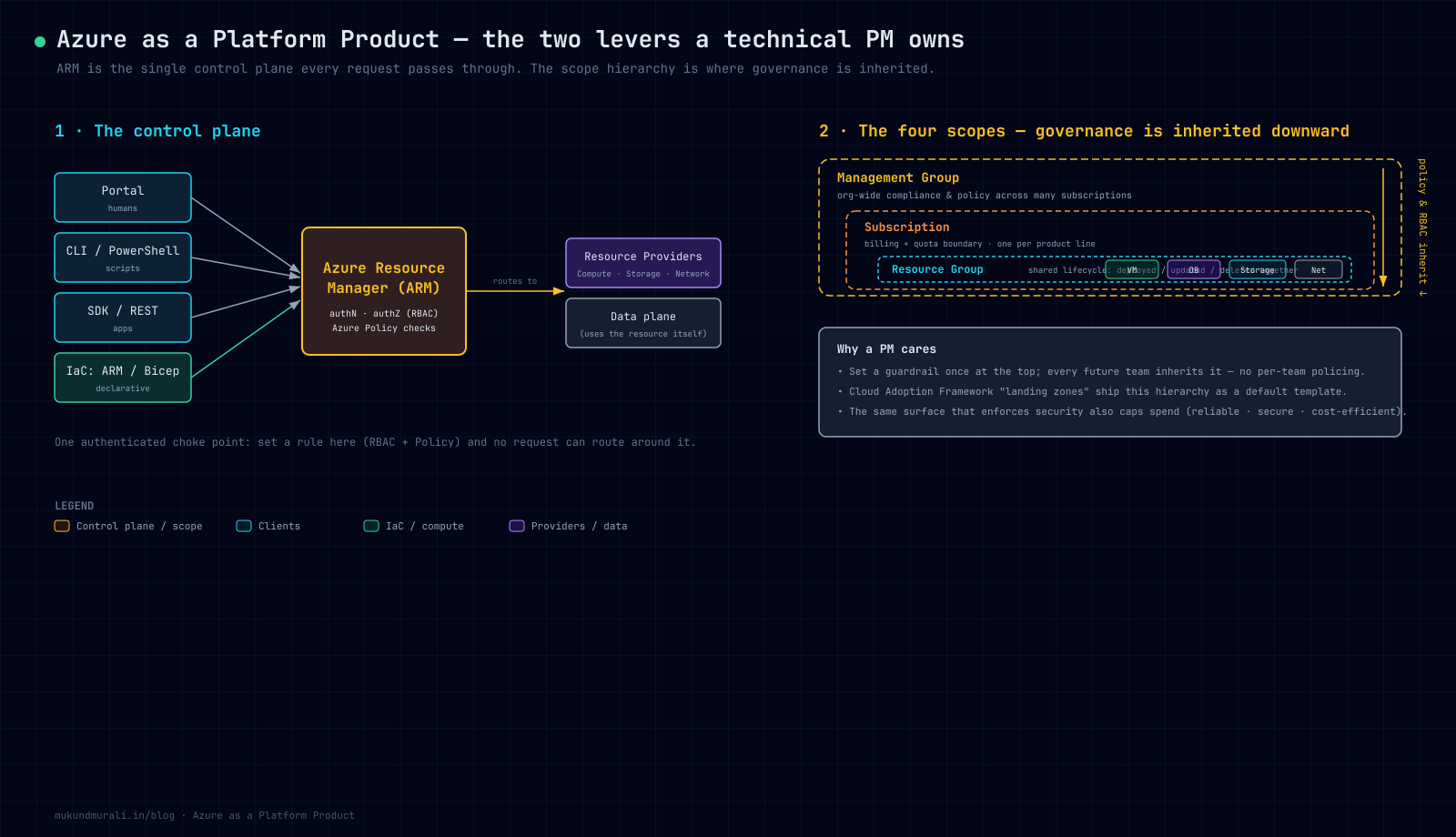
If you only internalize one thing about Azure, make it this. Azure Resource Manager is the deployment and management service that sits in front of everything. Every request from every tool — the portal, the CLI, PowerShell, the SDKs, the raw REST API — lands on the same ARM endpoint, https://management.azure.com, and ARM authenticates and authorizes it before forwarding it to the service that does the work. Because all the tools funnel through one API, you get consistent behavior no matter who clicks what or which script runs.
The distinction that makes this click for a PM is control plane versus data plane. The control plane manages resources: create a VM, provision a storage account. The data plane uses a resource's capabilities: RDP into that VM, read and write blobs in that account. Control-plane requests go to ARM; data-plane requests go to instance-specific endpoints. One consequence is worth holding onto for reliability conversations: the data plane keeps working even if the control plane is unavailable. Your running workloads don't fall over because provisioning is having a bad day.
Here's why that choke point is where I'd spend my attention. On every control-plane request, ARM automatically applies Azure RBAC, Azure Policy, management locks, and activity logging before the resource provider ever sees it. The Cloud Adoption Framework lays out the sequence plainly: is this a valid user (authenticated through Microsoft Entra ID), do they have sufficient permission (RBAC), is the action allowed by policy, is it within subscription limits, and is it within the financial commitment. Five gates, one path, enforced for everybody.
Read that sequence again as a product requirement. Security, compliance, and cost ceilings are not bolted on at the edges by individual teams remembering to be careful. They are structural. A PM who owns governance outcomes gets to encode them at the one place every request has to cross.
A few mechanics underneath ARM are worth knowing so you can reason about failure and scale:
- Resource providers do the actual work. ARM routes; it doesn't manage resources directly. Most resource types belong to a provider —
Microsoft.Computefor VMs,Microsoft.Storagefor storage,Microsoft.KeyVaultfor vaults — and a resource type is named{provider}/{type}, likeMicrosoft.KeyVault/vaults. The subscription has to be registered for a provider before you can use it. - RBAC governs who can act. A role assignment is a security principal plus a role definition plus a scope. It's an additive allow model — effective permissions are Actions minus NotActions — and deny assignments win when they apply.
- Policy governs what a resource is allowed to be. Azure Policy enforces standards and reports compliance down to the individual resource. Microsoft's own framing is the cleanest summary I've found: RBAC plus Policy together "provides full scope control" — one covers who, the other covers what.
- Concurrency is handled for you. If two requests try to update the same resource at once, ARM lets one win and returns HTTP 409 to the other. That built-in consistency guarantee is a small thing until the day it saves you from a corrupted deploy.
The PM takeaway: ARM is not plumbing you delegate and forget. It is the enforcement point for three of your outcomes at once. Design your guardrails to live there.
Section 2 — Infrastructure as Code: your environment as a product artifact
A platform you can't reproduce isn't a product. It's a pet. Infrastructure as Code is how you turn "the environment Priya set up last spring" into a versioned artifact you can review, test, and ship like any other.
Microsoft's definition is the one I use because it's refreshingly concrete: IaC uses a declarative model to define and deploy infrastructure, and "just as the same source code always generates the same binary, an IaC model generates the same environment every time it deploys." That sentence is the whole pitch.
The headline property is idempotency. Deploy the same file once or a hundred times and you land in the same end state, regardless of where you started. The Bicep docs put it bluntly: Bicep files are idempotent, so you deploy the same file many times and get the same resource types in the same state. This is the mechanism — not a best practice, a mechanism — that kills configuration drift and resource duplication. You stop asking "what's different about staging?" because the answer is "nothing, it's the same file."
Declarative versus imperative is the mindset shift. Declarative means you state what you want to exist, not the sequence of commands to create it. ARM figures out dependency ordering and parallelizes where it can, so you aren't scripting "create the VNet, wait, then the subnet, wait, then the NIC." You describe the end state; the engine sequences it.
ARM templates versus Bicep
Two authoring options, one engine. An ARM template is a JSON file that declares the resources to deploy. Bicep is a domain-specific language that transpiles to that exact same ARM JSON before anything is deployed — nothing in your subscription knows or cares which one you authored. That detail matters for a PM weighing a migration: adopting Bicep is not a new deployment engine or a new source of truth, it's a nicer front door to the one you already use.
| ARM templates (JSON) | Bicep | |
|---|---|---|
| Form | Verbose JSON | Concise DSL, roughly half the size |
| Deployment engine | ARM | ARM (Bicep transpiles to ARM JSON) |
| Tooling | Basic | Type safety, IntelliSense, modules |
| Dependencies | Often declared by hand | Managed automatically |
| New resource support | Available | Same-day support |
| State | Stateless — ARM is source of truth | Stateless — ARM is source of truth |
| Microsoft's stance | Supported | Recommended for new work |
Microsoft recommends Bicep for new work, and having read through both, the ergonomics argument is real: cleaner syntax, type checking, editor support, reusable modules, and automatic dependency management. For a PM, "half the size and type-safe" translates directly to fewer review cycles and fewer production surprises.
Where Terraform fits. Microsoft explicitly supports third-party IaC like Terraform through Azure providers, and Azure's own resource reference publishes Bicep, ARM JSON, and Terraform syntax side by side. The architectural trade-off a PM should understand before picking a lane: Bicep and ARM are stateless because ARM itself is the source of truth for resource state, whereas Terraform maintains its own state file. That state file is a real operational asset and a real operational liability — it needs to be stored, locked, and protected. Neither choice is wrong; they're different commitments.
Drift is a governance risk, not a dev annoyance. This is the part I'd escalate in a product review. Microsoft's own landing-zone testing guidance warns that manual, portal-based changes create configuration drift between environments and recommends an IaC approach specifically to avoid it. When someone fixes something by hand in the portal "just this once," they've created an undocumented difference between what's deployed and what's described. Multiply that across teams and your security posture becomes a rumor. IaC is how you keep the description and the reality the same thing.
Section 3 — Four scopes: the governance skeleton
Azure organizes everything into a parent-child hierarchy with four levels, and you can assign both RBAC and Policy at any of them. Top to bottom: Management Group, Subscription, Resource Group, Resource.
The superpower here is inheritance. A condition applied at a parent scope cascades down to every child. Assign Owner at a management group and that person manages everything in every subscription beneath it. Apply a policy restricting which regions a VM can be created in at a management group, and it flows down through nested management groups, subscriptions, and resources automatically. Set the guardrail once; every current and future team underneath it gets it for free. That is the single most important sentence in this post for a platform PM.
| Scope | What it governs | PM-relevant rules |
|---|---|---|
| Management Group | Access, policy, and compliance across many subscriptions | The governance layer above subscriptions; all subscriptions in one management group must trust the same Entra tenant; up to 10,000 per tenant, hierarchy of root plus 6 levels |
| Subscription | Billing and scaling-limit boundary | A clean seam for separating major product lines; each is tied to a single Entra directory for access |
| Resource Group | A set of resources sharing one lifecycle | Deployed, updated, and deleted together; each resource lives in exactly one group; groups can't nest; deleting the group deletes its contents; resources can span regions while the group's location only holds metadata |
| Resource | An individual manageable item | VMs, databases, storage accounts, web apps, VNets — the leaf level |
The scale guardrails are worth citing in a capacity conversation: 10,000 management groups per tenant, a hierarchy of root plus six levels with one direct parent each and unlimited subscriptions per group, around 980 resource groups per subscription, and up to 800 instances of a resource type per resource group. (Quota numbers shift, so confirm the live limits page at publish time rather than hard-coding them into a design.)
This is the Cloud Adoption Framework in disguise
The four scopes aren't an abstract taxonomy. They're the foundation of Azure Landing Zones. A landing zone is, in Microsoft's words, "a proven and flexible architecture for governing, securing, and scaling a multi-subscription Azure environment," and it splits into a platform landing zone — centralized governance, security, and shared services — and application landing zones for individual workloads. The whole thing is built on the management-group hierarchy, with each subscription inheriting policy from the management group it sits under.
The Cloud Adoption Framework's eight design areas include Resource Organization (management groups, subscriptions, naming) and Governance (policy, compliance, cost) — which is to say the framework is organized around exactly the levers in this post. Microsoft's recommended way to build landing zones is IaC-first, using the Azure Landing Zone accelerator with Azure Verified Modules for Bicep or Terraform, explicitly preferring code over the portal to avoid drift and keep environments repeatable and version-controlled. The pattern for handing a standardized, pre-governed subscription to a workload team is called subscription vending — and if you want a single phrase for what a platform PM ships, that's a strong candidate.
Why a PM should care: the thread running through all three
I've tagged the PM angle at each section, but it's worth pulling the thread tight, because these three constructs are not three features. They're the implementation of one job.
Treat the platform as a product. This is the Team Topologies thesis: platform teams provide internal services to stream-aligned teams so those teams can deliver with autonomy, and the good platforms offer a curated experience to internal customers, built as a "Thinnest Viable Platform" — the platform world's MVP. The deliverable is paved paths and self-service: standardized, secure, scalable routes that guide engineers through the requirements without slowing them down. Microsoft's Platform Engineering Capabilities Model even names the six capabilities a platform PM is implicitly managing — investment, adoption, governance, provisioning and management, interfaces, and measurement and feedback. That's a product backlog, not an ops checklist.
Security and reliability become governance-by-default. Because landing zones apply protections at the management-group level, new subscriptions inherit them automatically. The PM move is to encode reliability and security once, at the right scope, and let inheritance do the distribution. You are not writing a wiki page begging teams to be secure. You are making secure the path of least resistance.
Cost is an outcome you own. The FinOps Foundation's 2024 survey — 1,245 respondents representing around $55B in combined cloud spend — found that reducing wasted spend became the #1 priority for the first time, unseating "empowering engineers," with managing commitment discounts #2, cited by 43% (up from 7% a year earlier). Flexera's data shows waste has sat in the 27–32% band for years, around 29% in the most recent read. ARM gives you the control surface to act on that: policy, tagging, and the financial-commitment and subscription-limit gates that every control-plane request already passes through. The same choke point that enforces security enforces spend. A PM who ignores cost is leaving roughly a third of the budget on the floor by default.
Put those together and the architecture of this whole post is really one sentence: ARM's single authenticated choke point, idempotent IaC, and inherited guardrails are the three mechanisms behind reliable, secure, and cost-efficient — which is the entire job.
Conclusion
I didn't come to Azure as an Azure specialist. I came to it the way a lot of technical PMs will — as someone who already owned reliability, security, and cost on infrastructure, and needed to understand how this particular platform lets me own them at scale. What I found is a stack that rewards product thinking. ARM gives you one place to enforce the rules. IaC gives you an artifact you can version, review, and reproduce. The scope hierarchy gives you inheritance, so a decision made once protects everyone made after it.
None of this requires you to write the Bicep yourself. It requires you to know where the leverage is and to insist that your platform's guardrails live there instead of in a dozen well-intentioned runbooks. Platform engineering being a named discipline with real adoption numbers is the market telling us the same thing: someone has to own the platform as a product. If that's going to be a technical PM, this is the surface to start with. Set the guardrail once. Let inheritance carry it. Keep the environment in code. And treat the third of the budget that usually leaks as yours to defend.