The $4.4M Question: Why Technical PMs Can't Afford to Skip AI Governance

The $4.4M Question: Why Technical PMs Can't Afford to Skip AI Governance
Last quarter, I watched an AI feature I'd been championing get pulled from our roadmap three weeks before launch. The model worked. The accuracy was solid. The integration was clean. What killed it? We couldn't answer basic questions about bias testing, data lineage, or what happens when the model drifts. Not because the answers didn't exist — because nobody had been asked to produce them.
That experience forced me to confront something I think a lot of Technical PMs are quietly grappling with: we've gotten very good at shipping AI, and alarmingly bad at governing it.
The numbers back this up. Stanford's AI Index 2026 reports 362 documented AI incidents in 2025, up from 233 the year before — a 55% surge. EY's 2025 survey of 975 C-suite leaders found the average organization lost $4.4 million to AI-related risks. And perhaps most damning: 95% of enterprise GenAI pilots fail to deliver measurable P&L impact, according to MIT research. The failure mode isn't the model. It's everything around the model.
This post is the playbook I wish I'd had — a practical guide for technical PMs and engineering leaders who need to move responsible AI from a slide deck aspiration to an operational reality.
TL;DR
- AI incidents are surging (362 in 2025, up 55% YoY) and the average enterprise AI-related loss is $4.4M
- Governance pays for itself: organizations investing >10% of AI budget in ethics see 30% higher operating profit; governance delivers 31% faster time-to-market
- Three-layer governance stack: NIST AI RMF (risk language) → ISO 42001 (audit structure) → EU AI Act (legal floor)
- 90-day starter plan: inventory all AI systems (Days 1-30), run bias evaluations (Days 31-60), set monitoring and escalation paths (Days 61-90)
- The retrofit tax is real: building compliance after deployment costs 10-50x more than building it in parallel
- Start now: 75% of enterprises will have formal AI governance by end of 2026 — if you're not one of them, you're falling behind
The Regulatory Reality Has Changed
I spent years in infrastructure and networking, where compliance frameworks were part of the furniture. You didn't ship a product without understanding your SOC 2 obligations. AI is finally reaching that same inflection point — except the stakes are higher and the timelines are compressed.
The EU AI Act Is No Longer Theoretical
As of August 2026, the EU AI Act's transparency rules (Article 50) and enforcement powers are active. The EU AI Office can now request documentation, evaluate models, require corrective measures, and impose fines. Those fines? Up to €35 million or 7% of global annual turnover — whichever is higher.
The Digital Omnibus on AI (Regulation 2026/1744), which entered force in July 2026, simplified some implementation requirements and extended SME exemptions. But the trajectory is clear: high-risk AI system obligations hit in December 2027, and regulated product requirements follow in August 2028. If your AI touches EU users, the compliance clock is already ticking.
NIST AI RMF: The Voluntary Standard That Won
The NIST AI Risk Management Framework has become the de facto risk-management language for AI in the enterprise. Its four functions — GOVERN, MAP, MEASURE, MANAGE — give engineering teams a shared vocabulary that actually maps to how we build things. 57–67% of CISOs now reference it.
What I find particularly instructive is that the NIST AI RMF survived a change in US administration. Executive Order 14110 was rescinded in January 2025, but the framework — as a voluntary NIST publication — remained untouched. As one analysis put it: "Durable AI governance frameworks come from standards bodies with technical legitimacy, not from political documents that can be revoked with a signature." That's a lesson in building on the right foundations.
The GenAI Profile (NIST AI 600-1), released in July 2024, adds 12 risk categories and 200+ suggested actions specific to generative AI. If you're working with LLMs, RAG systems, or agentic workflows — and I assume you are — this document should be in your reference stack.
ISO 42001: The "SOC 2 of AI"
ISO/IEC 42001:2023 is the first certifiable international standard for AI Management Systems, and it's rapidly becoming the procurement gatekeeper. By 2026, it appears in over 50% of enterprise vendor questionnaires. Early certifiers include Microsoft, AWS, SAP, Anthropic, KPMG Canada, and Snowflake.
Here's the integration pattern that I've seen work in practice:
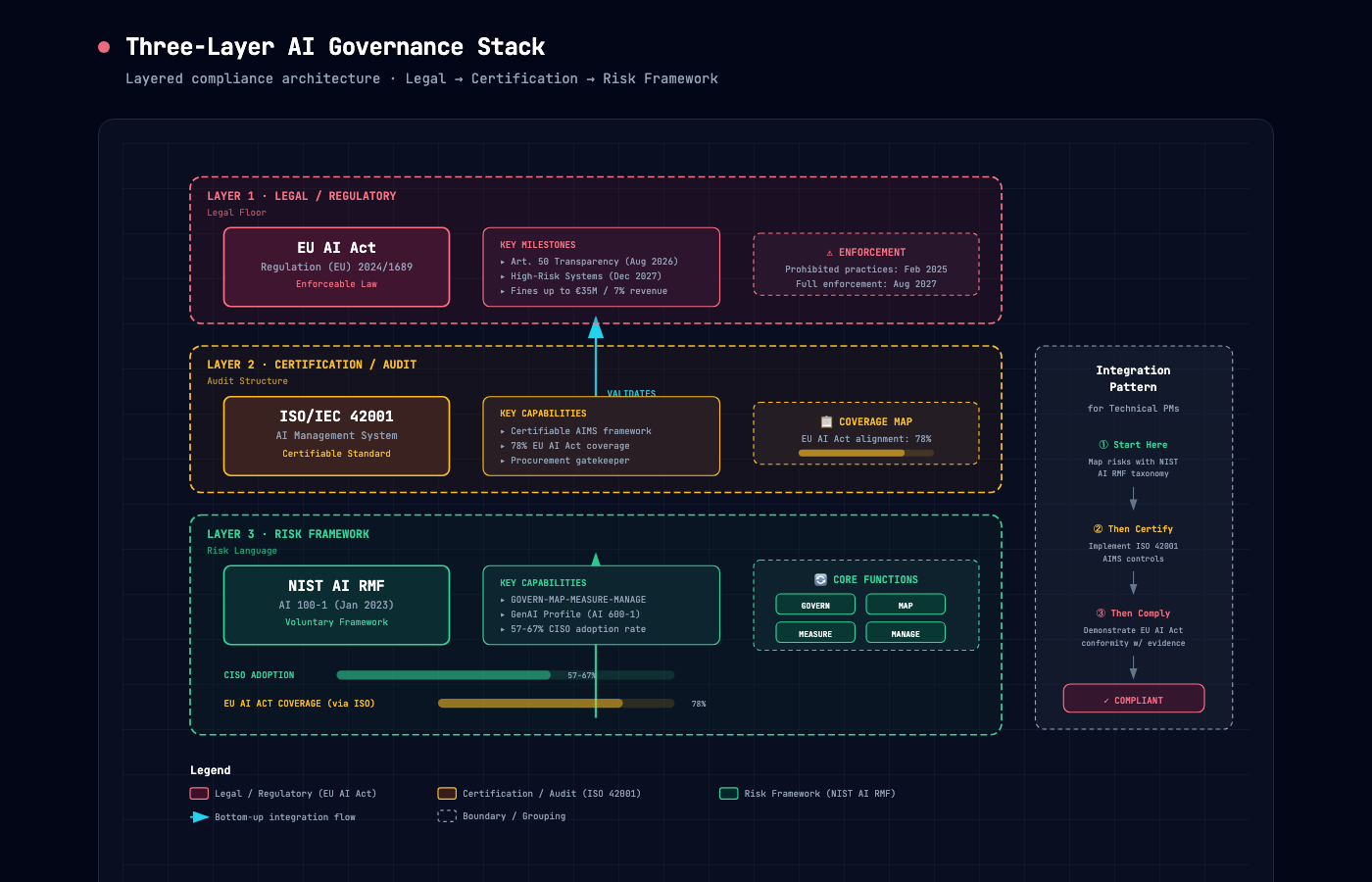
- NIST AI RMF provides the risk-management language your engineering teams already understand
- ISO 42001 provides the certifiable audit structure that produces the documentation auditors and procurement teams expect
- EU AI Act provides the legal floor — the mandatory obligations you cannot negotiate away
A CSA analysis found that a mature ISO 42001 program covers approximately 78% of EU AI Act operational requirements. That's not perfect overlap, but it's a significant head start.
The Cost of Getting It Wrong
Numbers are useful for planning. Case studies are useful for convincing people who don't want to plan.
The Pattern Is Consistent
Look across the major AI failures of the past two years and you'll see the same sequence: deploy without adequate governance → incident → litigation or settlement.
Clearview AI scraped billions of photos without consent for facial recognition and ended up paying a $51.75 million settlement — the largest biometric privacy class action to date.
UnitedHealth's nH Predict algorithm denied coverage with a 90% appeal reversal rate, meaning the AI was wrong nine times out of ten when challenged. A federal class action is pending.
Cigna's PxDx system reviewed over 300,000 claims in two months, with physicians spending an average of 1.2 seconds per claim review. That's not human oversight — it's rubber-stamping at scale. Class action active.
Air Canada's chatbot fabricated a bereavement fare policy and the company was held liable for its AI's statements. This one should haunt every PM deploying customer-facing AI: you own what your AI says.
And the privacy settlements keep climbing. Meta paid $1.4 billion to Texas over facial recognition data. Google paid $1.4 billion to Texas over data privacy violations. These are not rounding errors.
Healthcare: A Cautionary Domain
Healthcare AI deserves special attention because the bias patterns are both well-documented and deeply consequential. A 2025 study in NPJ Digital Medicine found that frontier LLMs prescribed inferior psychiatric care to Black patients when race was introduced into prompts. An LSE study testing Google Gemma across 29,616 summary pairs found significant gender bias in social care assessments. The Obermeyer et al. research demonstrated a healthcare algorithm that systematically underserved Black patients, affecting an estimated 200 million people annually.
If you're building AI that touches people's health, finances, or livelihoods, bias evaluation isn't optional — it's the minimum bar for responsible deployment.
The Aggregate Picture
The individual cases are dramatic, but the aggregate data is what should drive your planning:
- 51% of organizations experienced at least one negative AI consequence in the past year (McKinsey 2025)
- 99% of organizations reported some financial loss from AI-related risks; 64% lost more than $1M (EY 2025)
- 42% of companies abandoned a majority of their AI initiatives in 2025, up from 17% in 2024 (S&P Global)
- 80%+ of AI projects fail to deliver intended business value — twice the failure rate of non-AI IT projects (RAND 2024)
That last stat should stop you cold. We're not dealing with normal project risk. AI projects fail at double the rate of traditional IT — and the primary failure mode isn't technical. It's organizational.
The Business Case That Wins CFO Buy-In
Here's the framing that I've found actually works in budget conversations: don't lead with the cost of the governance program. Lead with the cost of not having one.
Cost of Inaction
The expected annual cost of ungoverned AI for a 1,500-person organization is approximately $4 million when you factor in breach exposure, compliance penalties, productivity fragmentation, and reputational damage. Over three years, the no-governance total cost of ownership is roughly $11.9 million versus $4.4 million with a governance platform — a 2.7x cost difference.
And there's a hidden accelerant: organizations that ban AI tools see 67% non-compliance within 90 days (Gartner 2025). Prohibition doesn't work. Shadow AI expands under bans. The only effective alternative to governance is governance.
The Upside Is Real
This is where the conversation shifts from "we need to spend money to avoid risk" to "this investment drives returns":
- Organizations spending >10% of their AI budget on ethics report 30% higher operating profit from AI (IBM, 915 executives surveyed)
- Organizations with responsible AI governance are 2.7x more likely to create enterprise-level value from AI (Accenture)
- PwC's system dynamics model projects responsible AI programs yield valuations up to 4% higher and revenues up to 3.5% higher, while reducing adverse incidents by up to 50%
- Formal AI oversight committees correlate with 35% more revenue growth, 40% more cost savings, and 40% higher employee satisfaction (EY 2025)
- Governance delivers 31% faster time-to-market, not slower (Obsidian Security)
That last point deserves emphasis because it defies the intuition that governance slows you down. In practice, clear policies, pre-approved patterns, and documented risk tolerances reduce the decision loops that actually slow AI deployment. Teams spend less time in review limbo when the governance framework gives them a clear path forward.
And one stat I keep coming back to: the governance hire pays for itself roughly 11x over — a $200K governance hire versus $2.24M in expected annual AI losses.
The Technical PM's Implementation Playbook
Enough theory. Here's what to actually do.
The 90-Day Starter Roadmap
This is adapted from NIST practitioner guidance and is designed to be achievable even if you're starting from zero.
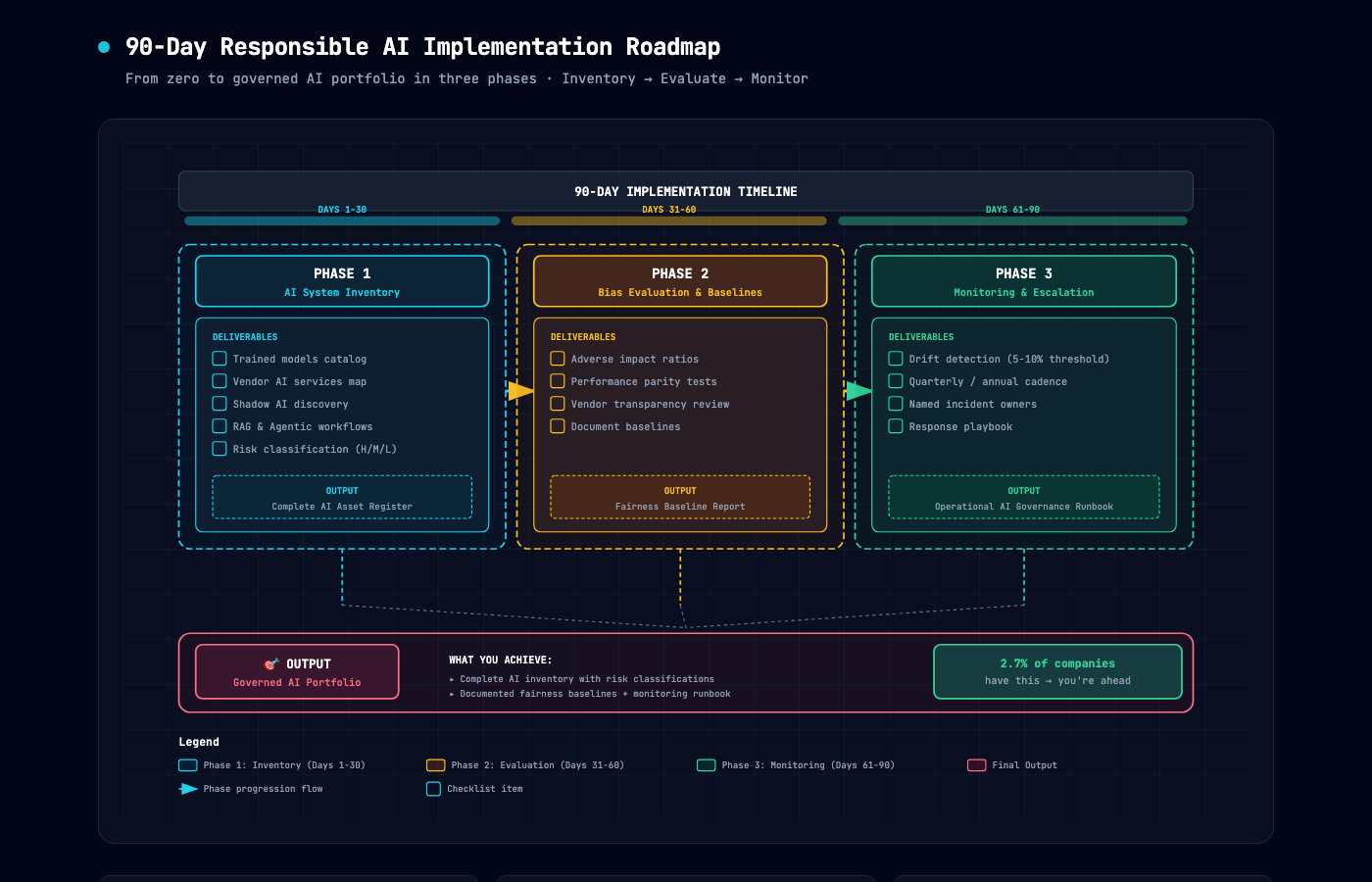
Days 1–30: Build Your AI System Inventory
Every system that makes, influences, or automates a decision goes on the list. This includes:
- Models you've trained or fine-tuned
- Third-party AI embedded in vendor products
- Shadow AI — the ChatGPT tabs, the Copilot integrations, the tools teams adopted without procurement approval
- RAG systems, agentic workflows, and automation pipelines
Assign risk classifications (high/medium/low) based on impact on people's rights, safety, and financial outcomes. Don't overthink the taxonomy — start with a simple spreadsheet and iterate. The UNESCO/Thomson Reuters Foundation report found only 2.7% of companies have a formal AI model registry. Having one at all puts you ahead.
Days 31–60: Run Bias Evaluations and Document Baselines
For every high-risk system:
- Run adverse impact ratios and performance parity tests across demographic groups
- Document performance baselines: accuracy, precision, recall, false positive/negative rates
- Review vendor AI documentation — push suppliers for transparency on training data, known limitations, and evaluation results
This step often reveals uncomfortable truths. That's the point. Stanford's AI Index found the Foundation Model Transparency Index dropped from 58 to 40 in 2025 — model providers are getting less transparent even as their models get more capable. You need to compensate for that gap with your own evaluations.
Days 61–90: Set Monitoring and Escalation Paths
- Set drift detection thresholds — flag models if metrics shift more than 5-10% from baseline
- Establish monitoring cadence: quarterly for high-risk systems, annually for low-risk
- Create escalation paths with named owners — not "the AI team," actual individuals
- Build an incident response playbook before you need it
The Tooling Reality
The AI governance platform market is nascent but growing fast. Gartner projects $492 million in spending in 2026, surpassing $1 billion by 2030. They published their first Magic Quadrant for AI Governance Platforms this year.
Dedicated platforms like IBM watsonx.governance, Credo AI, and OneTrust AI Governance are purpose-built. Cloud providers are embedding governance into existing platforms — Microsoft Purview, AWS Bedrock Guardrails, Google Vertex AI, Databricks Unity Catalog. GRC vendors like Collibra and BigID are expanding into the space.
My honest assessment: adoption is still early. Gartner estimates 30-40 vendors but few have deep customer references. Start with what your cloud provider offers, supplement with purpose-built tools for your highest-risk areas, and don't wait for the "perfect" platform before starting your governance program. A spreadsheet with clear ownership beats no governance at all.
The Gaps You Need to Close
Three areas where I see technical PMs consistently underestimating the challenge:
Shadow AI Discovery. Standard DLP and CASB tools miss AI-specific data flows. 40% of enterprise apps will include AI agents by 2026, up from less than 5% in 2025. You can't govern what you can't see.
Agentic AI Governance. This is the frontier I'm most focused on professionally. NIST AI RMF 1.0 was designed around human-in-the-loop systems. Agents act with discretion at machine speed. NIST received 937 public comments on agent security — the community knows this is an open problem. Only 21% of companies have a mature governance model for AI agents, despite 75% planning agentic AI deployment within two years (Deloitte 2026).
The Transparency Crisis. The Foundation Model Transparency Index is going the wrong direction. Training code, parameter counts, and dataset sizes are no longer disclosed for most frontier systems. If you're building on top of opaque foundation models, your governance program needs to account for that opacity with additional evaluation and monitoring.
Looking Ahead
Three trends that will shape how we practice responsible AI in the next 12-18 months:
Governance becomes a hiring signal. AI-specific governance roles grew 17% in 2025. The share of businesses with no responsible AI policies fell from 24% to 11%. This is moving from optional to expected. Gartner predicts 75% of enterprises will have formal AI governance programs by end of 2026.
Responsible AI dimensions will conflict with each other. Stanford's AI Index noted that "improving one responsible AI dimension, such as safety, can degrade another, such as accuracy." This is an engineering trade-off, not a policy one. Technical PMs need to own these trade-off decisions explicitly, with documented rationale and stakeholder alignment.
The "AI high performers" are pulling away. McKinsey's 2026 State of AI finds only 6% of organizations qualify as AI high performers — those that redesign workflows, invest over 20% of digital budgets in AI, and are 3x more likely to have fundamentally transformed their operations. What separates them? It's not model sophistication. It's organizational integration, workflow redesign, and — yes — governance.
Start Here, Start Now
If you take one thing from this post: responsible AI governance is not overhead — it's the infrastructure that determines whether your AI investments generate enterprise value or liability.
Here's what I'd do Monday morning:
- Inventory your AI systems. All of them. Including the shadow ones. A shared doc with system name, risk level, and owner is enough to start.
- Assign an owner for AI governance. Not a committee — a person. Even if it's you, temporarily.
- Run your first bias evaluation on your highest-risk AI system. Document what you find.
- Read the NIST AI RMF — the core document is 40 pages. It's well-written. It will give you the vocabulary to have governance conversations with your engineering team and your leadership.
- Build the business case using the data points in this post. Lead with $4.4M average loss, not the cost of the solution.
Building compliance infrastructure after deployment costs 10-50x more than building it in parallel with your AI systems. Every sprint you ship without governance is technical debt accumulating at a rate that will eventually demand full repayment — with interest.
The organizations that figure this out will be the ones still deploying AI in two years. The ones that don't will be the case studies in someone else's blog post.
Mukund Murali is a Technical PM focused on AI product strategy, agentic workflows, and autonomous systems. He writes about building AI products that actually work — technically, ethically, and commercially.